TL;DR: Balancing liquidity, security, and regulatory compliance, cbBTC emerges as the preferred collateral option. While wBTC remains viable, its governance concerns and recent waning popularity warrant a cautious approach.
Introduction
This is a deep dive into the two largest wrapped Bitcoin tokens by market cap, Wrapped Bitcoin (wBTC) and Coinbase Wrapped Bitcoin (cbBTC), aimed at answering these important questions:
Which presents more risk - being rugged by Justin Sun or having my individual address blocked by Coinbase?
Who controls the BTC that backs wBTC?
How has Coinbase dealt with blacklisting addresses from a historical perspective?
Executive Summary
The decision between using Wrapped Bitcoin (wBTC) or Coinbase Wrapped Bitcoin (cbBTC) involves considerations of governance, custodianship, security, regulatory risks, and liquidity. Key structural differences make cbBTC the preferred choice for a compliant and future-proof lending platform, while wBTC carries deeper liquidity with governance risks and higher exposure to risk of regulatory impact.
wBTC has deeper liquidity but carries the risk of Justin Sun’s involvement and an international governance structure. cbBTC is centralized but brings bullish adoption and faster withdrawal times. It will also directly benefit from a crypto-friendly administration in the United States.
Freeze Functionality
No built-in address-level freeze or blacklist function. However, a token-wide freeze function is in place in wBTC’s smart contracts.
Coinbase can freeze cbBTC all assets or blacklist specific addresses via the smart contract.
Upgradeability & Contract Control
wBTC’s contract has been effectively fixed in practice, but is upgradeable with the approval of the wBTC DAO.
cbBTC’s smart contract is upgradeable at Coinbase’s discretion.
The backing BTC for wBTC is publicly verifiable on-chain (Bitcoin addresses holding the custodial BTC are disclosed) BitGo’s custody is regularly audited by third parties to ensure BTC reserves match wBTC supply.
Coinbase maintains on-chain Proof-of-Reserves for cbBTC, publishing BTC reserve addresses to confirm 1:1 backing. The cbBTC smart contracts (which share code with Coinbase’s cbETH) were audited by OpenZeppelin for security.
Key Findings
Governance & Control
wBTC governance is structured as a multi-custodian model but has come under scrutiny due to BitGo's joint venture with BiT Global, a Hong Kong-based entity linked to Justin Sun. This has raised concerns over transparency and control, leading to its removal from major platforms like MakerDAO and Coinbase.
cbBTC is entirely governed by Coinbase, ensuring clear accountability and centralizing control over minting, burning, and contract upgrades.
wBTC issuance is governed by a multi-signature smart contract requiring 8 of the 13 signers to approve any transaction.
wBTC custody, and the BTC backing every wBTC, is held by the joint venture made up of BitGo and BiT Global in multi-signature addresses. A 2 of 3 approval is required to move funds. All three of these keys are held by BiT Global and BitGo.
There is no evidence of a DAO vote approving the joint venture with BiT Global.
Custodianship & Asset Segregation
wBTC’s backing BTC is held by BitGo and BiT Global.
cbBTC’s reserves are held by Coinbase.
Security & Transparency
wBTC smart contracts include blanket freeze and upgrade functions, and have a strong security track record, but jurisdictional changes could increase exposure to more regulatory requirements.
cbBTC smart contracts include freeze, blacklist, and upgrade functions, making it more centralized but compliant with legal requirements.
Regulatory Considerations
wBTC could face regulatory pressures due to its shifting governance structure.
cbBTC benefits from Coinbase’s regulatory compliance, making it a more viable option for lending platforms with institutional users.
Suitability for High-Volume Lending
wBTC currently has deeper liquidity, but cbBTC is growing rapidly and has strong adoption across major DeFi protocols.
cbBTC’s redemption mechanism through Coinbase ensures robust liquidity support, reducing execution risks in large liquidations.
👮♂️ Governance and Control
wBTC’s recent shift to a multi-jurisdictional custody model introduces added exposure to the risk of regulatory impact. Conversely, the new American administration is outspokenly pro-crypto, making Coinbase well-positioned to see cbBTC become a preferred option amongst institutional investors. Additionally, cbBTC benefits from Coinbase’s crime insurance policy, which would fully compensate users in the case of losing the underlying BTC backing cbBTC. Although liquidity is clearly deeper in wBTC, that remains its sole advantage, and it may not remain true for much longer.
Wrapped BTC
Wrapped BTC is a role-based DAO structure.
Custodians The institution or party who holds the asset. BitGo in a joint venture with BiT Global.
Merchant The institution or party to which wrapped tokens will be minted to and burnt from. Merchants play a key role in distribution of the wrapped token. In the case of WBTC, this will be played initially by Kyber [5] and Republic Protocol [6]. Each merchant holds a key to initiate minting of new wrapped tokens and burning of wrapped tokens.
User The holders of the wrapped token. Users can use wrapped tokens to transfer and transact like any other ERC20 token in the Ethereum ecosystem.
wBTC DAO member - Contract changes and addition/removal of custodians and merchants will be controlled by a multi-signature contract. Holders of the keys to the multi-sig contract will be held by institutions as part of the wBTC DAO.
Custodians exchange assets for wrapped tokens with merchants. This is done through two different types of transactions; minting (creation of wrapped tokens) and burning (reducing supply of wrapped tokens). These transactions will be available publicly and can be viewed by anyone through a block explorer. After the initial exchange, merchants aim to maintain a buffer of wrapped tokens so that they can exchange them with users. The two-step minting process helps reduce the time it takes for users to get wrapped tokens, as minting and burning are more time-consuming processes.
BitGo’s recent venture with BiT Global doesn’t appear to have been subjected to a DAO vote for approval. Its effects have been considerable.
In August 2024, BitGo announced the transfer of the wBTC business into a joint venture with BiT Global (a Hong Kong–based trust company) to create a “multi-jurisdictional and multi-institutional custody structure”. BitGo framed this as enhancing security via geographically distributed custody.
This partnership introduced Justin Sun as an advising member of BiT Global. BitGo CEO Mike Belshe publicly confirmed Sun’s role but emphasized that Sun “doesn’t have the ability to move funds” and holds no management position or ownership stake in wBTC’s keys.
In reaction to this news, a MakerDAO forum analysis in Sept 2024 concluded it was “highly likely that Justin Sun or affiliates control BiT Global, with ownership concealed through shell companies and nominee directors,” citing evidence from corporate records linking BiT Global’s principals to Sun. The analysis and ensuing proposal noted Sun’s significant negative track record with custodial projects, including reduced transparency in TrueUSD (TUSD) after he took control and questionable reserves management in other ventures.
BA Labs (Maker’s risk unit) flatly stated that given the potential for concealed ownership, “legal due diligence would not provide an adequate level of assurance” that wBTC would remain safe. This culminated in MakerDAO (Sky) voting in Sept 2024 to offboard all wBTC from its collateral, with 88% of votes in favor of removal.
Notably, BitGo did not put the custody change to a vote of the broader wBTC DAO., suggesting that this critical decision was made by the central custodians without full community governance—further indicating centralization.
In summary, by late 2024 wBTC’s governance structure had shifted from a mostly trusted consortium model to a more opaque arrangement where one entity (BitGo-BiT Global) controls custody. This raised the specter of unilateral control: if Sun or any insider can direct custodial actions, they could in theory affect wBTC issuance/redemption or undermine the peg.
Summary
To the degree established above, governance is decentralized, although the decision to bring Tron founder Justin Sun into the picture last year doesn’t appear to be the product of a DAO vote. This has sparked concerns over Sun’s influence on wBTC’s reserves and operations. The extent of Justin Sun’s power to move funds is unknown, but quotes from a Blockworks interview with BiT Global CEO describe reasonable measures in place to limit any single person’s ability to affect reserve funds.
Despite these comments, the reactions of Coinbase and Sky (formerly MakerDAO) to discontinue use of wBTC in light of Sun’s involvement should be appropriately weighted. Not only have these withdrawals from the wBTC ecosystem had a measurable impact on liquidity, but the impact of two major American-based crypto organizations abandoning wBTC is consequential.
Coinbase’s cbBTC
Coinbase’s cbBTC has a single-issuer governance model.
Coinbase is the sole party that mints new cbBTC when users deposit BTC and burns cbBTC when users redeem for BTC.
There is no DAO or external governance: control rests entirely with Coinbase’s internal processes and smart contract admins.
The cbBTC smart contract is upgradeable and contains administrator functions (including a freeze capability) that Coinbase controls, meaning they can unilaterally change contract logic or policies, subject only to its own corporate governance and any applicable regulation.
Coinbase is a regulated, US-based public company with audited financials.
Its decision-making is likely to be more transparent (to regulators if not to the public) and constrained by law compared to a multi-jurisdictional entity. There is no mystery about who controls cbBTC, it’s Coinbase – but that also means cbBTC holders are entirely dependent on Coinbase. In summary, cbBTC’s governance trades decentralization for trust in a known institution.
cbBTC’s governance is straightforwardly centralized under Coinbase. Coinbase alone mints, burns, and oversees cbBTC, which does raise some concern about unilateral control, but within a regulated public company accountable to shareholders and the United States government.
Risks of Unilateral Control
Both models involve some degree of centralized control. For a detailed comparison of the functions present in each smart contract, please see the Appendix.
With wBTC, the risk is governance capture:
If Justin Sun or another actor gained enough control, they could potentially influence decisions like halting redemptions or even fraudulently minting tokens.
The lack of granular control is by design to prevent arbitrary blacklisting, but it also means if control falls to one party, wBTC could, in theory, be paused or manipulated against the original governance intentions.
For cbBTC, unilateral control is more straightforward:
Coinbase, via its designated administrators, can upgrade or pause the cbBTC contract and can freeze individual addresses.
This means Coinbase could single-handedly freeze or render cbBTC unusable for certain users if it chose (or was compelled by authorities). There is also the extreme scenario of Coinbase mismanaging cbBTC (e.g. minting unbacked cbBTC), though as a regulated entity with audits, this risk is mitigated by oversight and the company’s own incentives and insured according to the Coinbase User Agreement. The key risk is if Coinbase were to act in its own interest over cbBTC holders. For example, if facing legal orders or financial distress, Coinbase could prioritize its corporate survival over honoring cbBTC redemption promptly.
From a pure governance standpoint, cbBTC provides clearer lines of accountability. If Coinbase does something wrong, it’s identifiable and there may be legal recourse. wBTC’s governance has become clouded with this mixture of a DAO structure, multi-national jurisdiction, and the potential influence of Justin Sun. The events of late 2024 already indicate that many in the industry view wBTC as having unacceptable governance risk, prompting moves away from it.
Custodianship and Asset Segregation
wBTC: Historically custodied by BitGo Trust (a U.S.-qualified custodian), as of late 2024, wBTC reserves are now split between BitGo and BiT Global (Hong Kong). This arrangement was intended to enhance security but introduces additional oversight complexity. Each wBTC token should be matched by BTC in segregated custodial wallets under the wBTC program. BitGo advertises fully segregated reserves, and as a trust company, it is legally required to keep client assets separate from its own.
cbBTC: Reserves backing cbBTC are custodied by Coinbase’s regulated trust entity. Coinbase Wrapped Bitcoin (cbBTC) is a 1:1 tokenized BTC issued by Coinbase, and the actual Bitcoin reserves behind every cbBTC are held under the custody of Coinbase Custody Trust Company, LLC, rather than commingled in Coinbase, Inc.’s general corporate accounts. Coinbase Custody Trust is a separate, limited-purpose trust company chartered by the New York Department of Financial Services (NYDFS).
wBTC Custody Breakdown
Every wBTC token is backed by BTC held by custodians.
BitGo has historically published on-chain addresses for its BTC reserves, ensuring transparency.
With the August 2024 joint venture, custodianship is now shared between BitGo and BiT Global.
The multi-institutional custody model requires a 2/3 multi-signature control system, requiring both parties to authorize transactions.
While BitGo is a long-established entity with a solid track record, BiT Global is relatively new and lacks transparency.
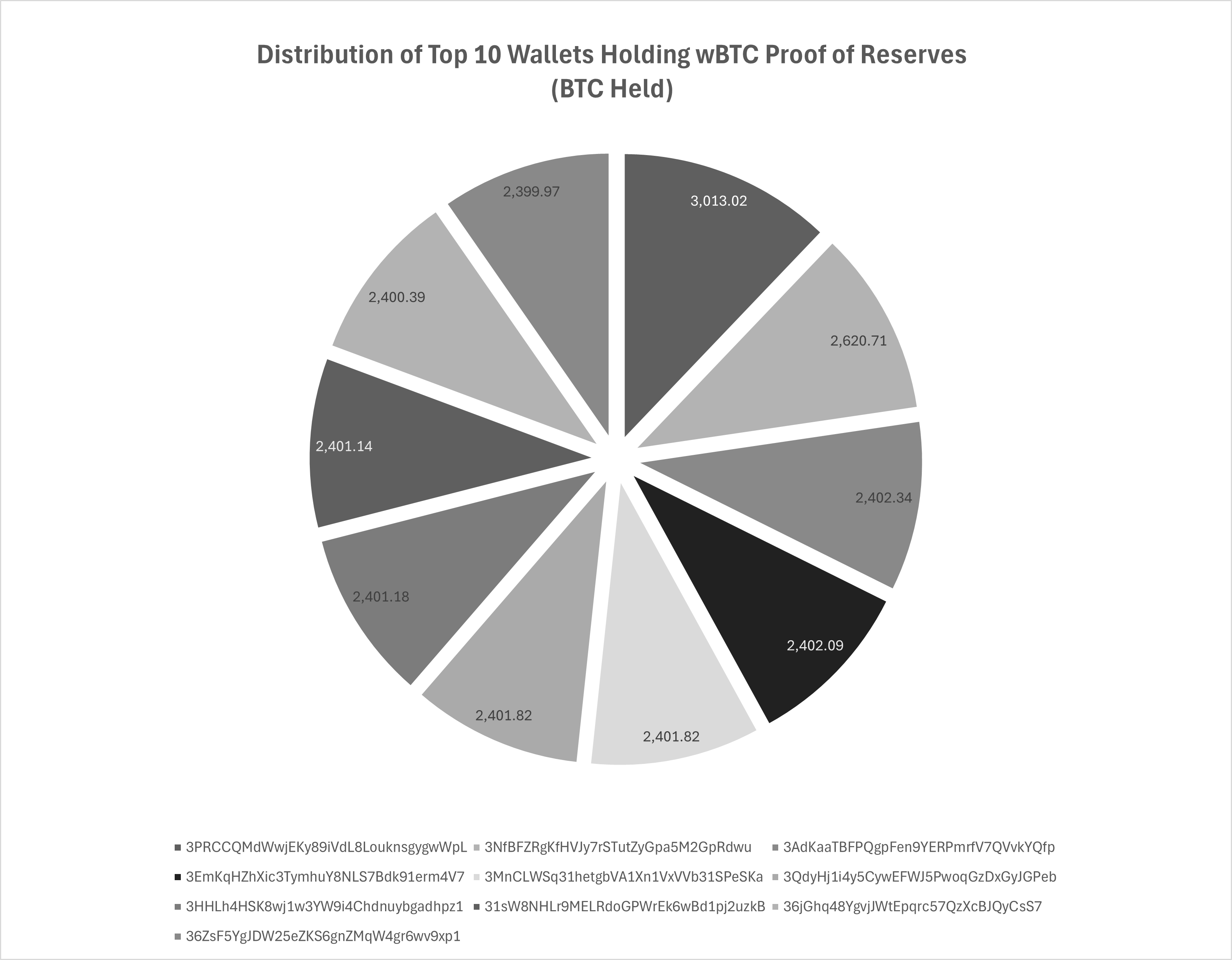
Distribution of Top 10 Wallets holding wBTC proof of reserves.
cbBTC Custody Breakdown
Coinbase holds the BTC backing cbBTC
Coinbase launched a **Proof of Reserves** page for cbBTC in February 2025, listing BTC wallet addresses that support full backing of cbBTC, addressing transparency concerns.
🛡️ Security and Regulation
Both assets have strong security track records, but their transparency mechanisms differ. Both currencies maintain on-chain proof of reserves and public audits. Coinbase has kept billions of dollars in crypto safe over the years, and there have been no incidents of cbBTC mismanagement to date. wBTC also has a solid track record, having never publicly suffered a significant de-pegging event or successful attack.
wBTC has a robust track record with no major security breaches but now faces custodial trust issues.
cbBTC’s initial transparency gap has been addressed through proof-of-reserves publication..
Both assets have maintained their 1:1 BTC peg.
wBTC has increased its exposure to regulatory scrutiny by moving to a model that requires compliance with both the United States and Hong Kong. Although this currently causes no problem, the risk of regulatory changes impacting wBTC have effectively been doubled as a result of this move. Coinbase is subject solely to the United States government in terms of regulatory compliance. Coinbase delisted wBTC in November 2024 due to governance concerns, and MakerDAO followed suit by removing it as collateral. For a complete breakdown of the lawsuit, please see the **Appendix.**
Coinbase’s delisting of wBTC signaled increased compliance risks.
wBTC’s association with BiT Global and Justin Sun adds uncertainty.
cbBTC benefits from Coinbase’s clear regulatory framework and compliance track record.
📈 Growth Trends and Adoption
wBTC supply is declining, cbBTC supply is rising
wBTC Supply Decline: wBTC’s circulation has been shrinking amid trust concerns. By Dec 2024 it accounted for only about 0.74% of Bitcoin’s total supply, down from roughly 1.5% two years prior. Following Coinbase’s delisting announcement in Nov 2024, over 5% of all wBTC (~5,800 tokens, ~$500M) were quickly redeemed back to BTC within weeks, reflecting users’ caution.
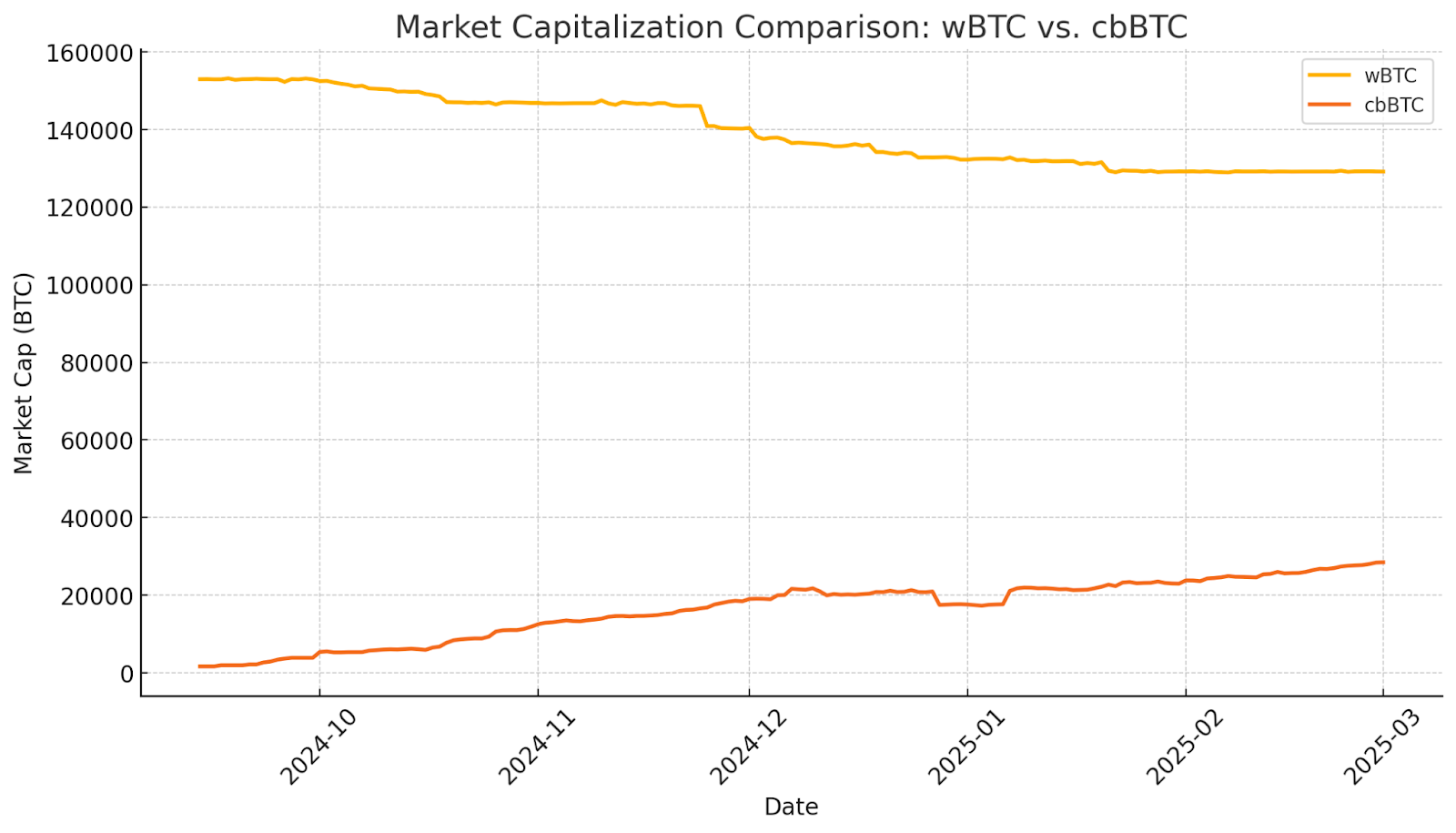
cbBTC’s Rapid Rise: Coinbase’s cbBTC has seen tens of thousands of BTC bridged into the token within a few months. By early 2025, ~25–28k cbBTC were in circulation (market cap around $2.4 billion), making it a top-50 crypto asset by size. This uptake indicates growing user interest in Coinbase’s custodial Bitcoin token for DeFi use.
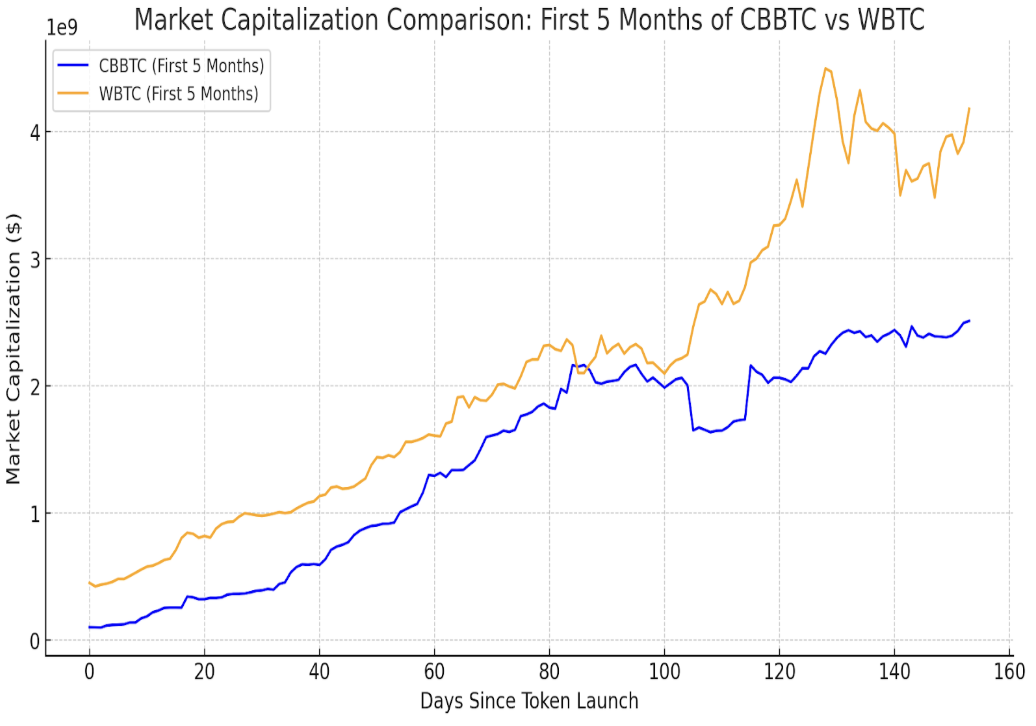
Market capitalization of Wrapped BTC (wBTC) vs. Coinbase Wrapped BTC (cbBTC) for the first 160 days of their respective launches.
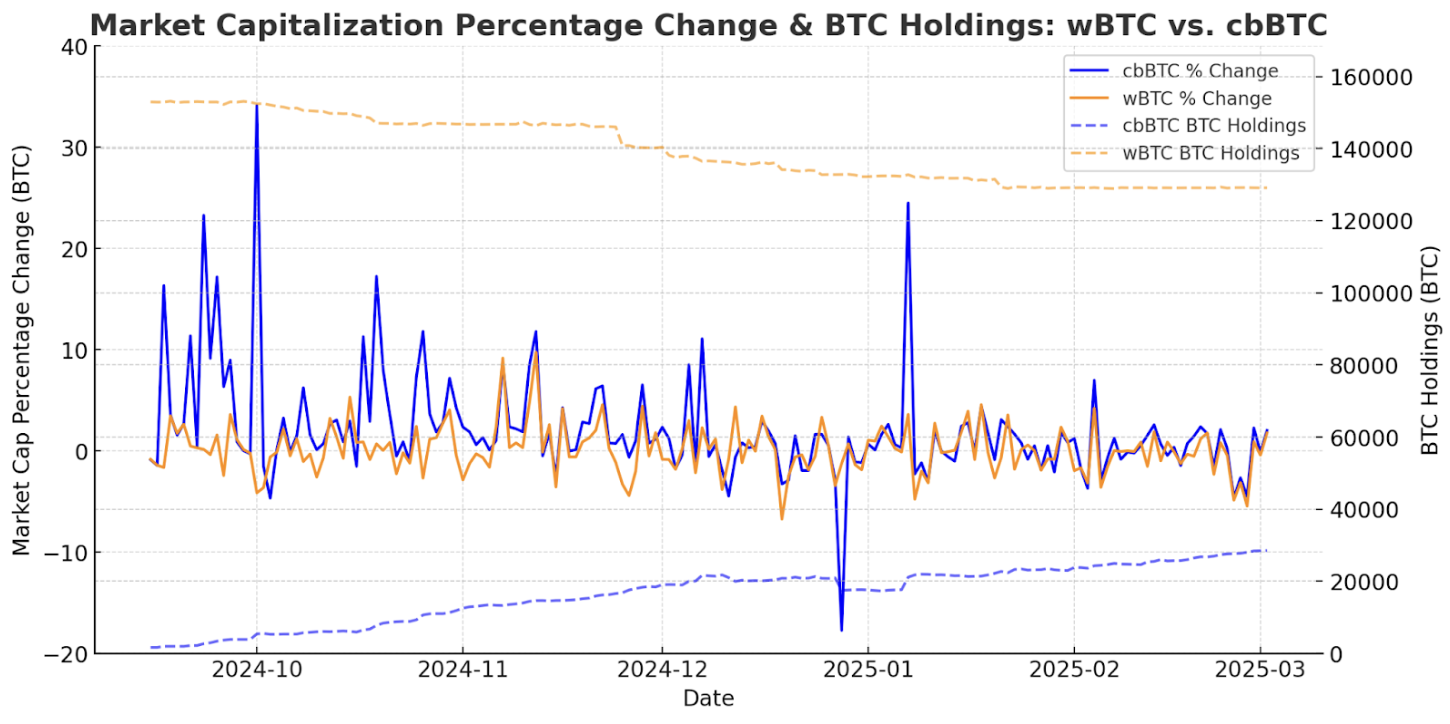
A zoomed out representation of each market cap from October 2024 to February 2025. wBTC maintains dominance, but cbBTC has shown rapid growth, indicating increasing adoption.
Partnerships and Integrations
**Expansion to Solana:** In November 2024, Coinbase expanded cbBTC to the Solana ecosystem. Users can send Bitcoin to Coinbase and receive cbBTC on Solana to deploy in Solana’s DeFi protocols. Coinbase jump-started this integration by seeding ~$10 million of cbBTC liquidity on Solana, plus $500k in trading pools, positioning cbBTC as a new standard for Bitcoin-based DeFi on Solana.
**wBTC Custody Joint Venture:** BitGo’s entrance into a joint venture with Hong Kong’s BiT Global (a firm partially owned by Tron’s Justin Sun) to share custody of wBTC reserves has had a palpably negative effect amongst wBTC users industry-wide.
Funding and Institutional Investments
**Trump-Backed WLFI Buys wBTC:** World Liberty Financial (WLFI), a DeFi platform backed by Donald Trump, made notable crypto purchases in early 2025 as part of its “Macro Strategy” reserve. In February 2025, WLFI spent $5 million USDC to acquire 52 wBTC alongside other token buys. This move suggests growing interest from politically affiliated and institutional players in holding wrapped Bitcoin as part of diversified crypto portfolios.
Coinbase’s Investment in DeFi Liquidity: Coinbase itself has made strategic allocations to promote cbBTC’s adoption. As noted, Coinbase injected $10M of its BTC liquidity into Solana via cbBTC. This can be seen as an investment in fostering cross-chain liquidity for Bitcoin. Moreover, Coinbase’s long-standing institutional custody business (holding billions in BTC for clients) underpins cbBTC’s launch. While not a third-party funding event, Coinbase’s initiative reflects a major institutional commitment to the wrapped BTC space, effectively reallocating some Bitcoin liquidity into DeFi-oriented channels.
Whale Activity and Major Transactions
**wBTC Flash Crash on Binance:** On Nov 23, 2024, wBTC experienced a dramatic flash crash on Binance, plummeting momentarily to about $5,200 before rebounding near its prior price (~$97k) within the same day. The incident, isolated to Binance due to a technical glitch, caused a brief 94% drop on that exchange. It coincided with the uncertainty from Coinbase’s delisting news, amplifying market jitters. The swift recovery underscored the event’s isolated nature and the general resilience of wBTC’s peg on other platforms.
**Large Redemptions (“Great Unwinding”):** In the weeks after Coinbase’s announcement, major wBTC holders (whales) rushed to redeem wBTC for real BTC. This “great unwinding” saw wBTC supply shrink by over 5%. Notably, Tron founder Justin Sun reportedly redeemed a substantial amount of wBTC on his exchange (HTX) around this period. These large withdrawals by whale entities drove wBTC’s total value locked sharply downward, reflecting eroding confidence. (Ironically, BiT Global later cited the resulting market impact as harm caused by Coinbase’s delisting move.)
**Surge in cbBTC Volume:** The rollout of cbBTC also involved significant Bitcoin movements. Thousands of BTC flowed into Coinbase to mint cbBTC, including likely large holders seeking a trusted bridge. By late 2024, cbBTC was seeing hundreds of millions in daily trading volume (~3.95k cbBTC traded in 24h, or $332M turnover in one sample day). This high volume suggests active whale participation, either arbitraging between wBTC and cbBTC or positioning into cbBTC for DeFi use. Coinbase’s deep liquidity provision (and users’ BTC deposits) indicate that substantial Bitcoin reserves were mobilized to back cbBTC, marking one of the largest cross-chain BTC transfers by value in the period.
✅ Conclusion
In comparing wBTC and cbBTC, wBTC shows strength in its strong security track record and deep liquidity advantage. Its decentralized consortium model (multiple merchants and custodians) and immutable contracts limit the likelihood of unilateral abuse, though it is still a custodial token at its core, and its new association with Justin Sun is a valid cause for concern. cbBTC, on the other hand, leverages Coinbase’s trusted brand at the cost of explicit centralization. Each wrapped Bitcoin has security trade-offs: wBTC leans towards a decentralized trust-but-verify model with multiple external checks, while cbBTC leans on a single trusted operator mode.
(insert image)
In short, wBTC has deeper liquidity and characteristics of a decentralized model while cbBTC has faster redemption times, a rapidly expanding ecosystem, brand recognition, and no scandalous associations.
Liquidity: wBTC still leads but cbBTC is growing rapidly with strong institutional adoption.
Adoption: Major DeFi platforms are increasingly shifting toward cbBTC.
Risk: wBTC faces governance concerns, while cbBTC carries centralization risks.
Operational Security: Both are highly secure, but cbBTC benefits from Coinbase’s custody expertise.
For a lending protocol aiming to balance liquidity, security, and regulatory compliance, cbBTC emerges as the preferred collateral option. While wBTC remains viable, its governance concerns and recent waning popularity warrant a cautious approach.
🗄️ Appendix
MakerDAO/Sky Abandonment
On August 9th, 2024, Bitgo announced a joint venture with BiT Global to transfer control of wBTC, resulting in custodianship being split across multiple jurisdictions. Part of this change included a partnership between Bitgo and Justin Sun. The next day, a proposal was posted on the Sky (formerly MakerDAO) governance forum that called for offboarding all wBTC held by Sky.
August 2024 - BitGo partnership with BiT Global. BiT global lists Justin Sun as a strategic advisor.
Robert Liu, a director at BiT Global, emphasized that Sun's role was primarily as a strategic advisor, facilitating initial discussions between BitGo and BiT Global.
Liu clarified that Sun did not hold a management position, ownership stake, or control over the private keys of wBTC reserves.
BitGo's CEO, Mike Belshe, reinforced this by stating that BiT Global's team is responsible for asset safekeeping and operates independently, without undue influence from Sun or others.
September 2024 - MakerDAO (now Sky) votes to offboard all wBTC collateral exposure from the Sky Ecosystem, including Legacy Vault Types and SparkLends.
According to conversations on Sky’s DAO forums, it is likely that Justin Sun or affiliates control BitGlobal, with ownership concealed through shell companies and nominee directors.
Justin Sun affiliated stablecoins and custodial products have a significant negative track record and pose elevated counterparty risk.
Given evidence of concealment and concerns about validity of previous disclosures for Sun affiliated entities and products, I’m not sure an adequate level of assurance is obtainable.
Coinbase Lawsuit
November 2024 - Coinbase announced delisting of wBTC, effective 12/19/24.
This was driven by concerns over Justin Sun’s involvement with wBTC’s custodian, BiT Global.
Exact language was ‘unacceptable risk’.
BiT Global filed a lawsuit against Coinbase for delisting on 12/13/24, citing monopoly.
wBTC was denied issuance of a restraining order that would bar Coinbase from delisting wBTC.
Coinbase filed a motion to dismiss on Jan.21st. Hearing set for April 3rd.
Summary of the Legal Complaint:
The lawsuit, filed by BiT Global, challenges Coinbase’s decision to delist Wrapped Bitcoin (wBTC) from its platform. BiT argues that this move was anti-competitive and unlawful, aiming to suppress competition in the wrapped Bitcoin market. The key allegations in the complaint include:
Antitrust Violations – BiT claims that Coinbase’s actions harmed competition by excluding a competing wrapped Bitcoin product from its exchange while simultaneously promoting its competing asset, cbBTC.
False and Misleading Statements – The complaint asserts that Coinbase misrepresented the reasons for wBTC’s delisting, falsely claiming it did not meet the platform’s listing standards when, according to BiT, Coinbase applied these standards arbitrarily.
Unfair Business Practices – BiT contends that Coinbase’s decision to delist wBTC was not based on legitimate concerns about the asset but rather a strategic effort to eliminate a competitor and boost its financial products.
Harm to Market Participants – The delisting allegedly caused financial harm to BiT, users of wBTC, and investors who relied on Coinbase’s platform for trading the asset.
Refusal to Deal & Exclusionary Conduct – BiT asserts that Coinbase’s actions amount to a refusal to deal, which, under certain antitrust principles, could be unlawful if the refusal lacks a legitimate business justification and harms competition.
Analysis of the Complaint’s Merit:
Strength of Antitrust Argument
The Sherman Act prohibits exclusionary conduct that harms competition, not just individual competitors. BiT would need to prove that Coinbase’s actions harmed competition as a whole, not just that it was personally disadvantaged.
Coinbase does not have a duty to list wBTC, and there is no clear evidence that removing it created monopolistic conditions in the wrapped Bitcoin market.
Courts have repeatedly held that businesses have discretion in deciding whom to deal with, and BiT’s claims appear to fail the established legal tests for exclusionary conduct.
Allegation of False Statements
Coinbase has published listing standards, which it claims wBTC no longer met.
BiT argues that Coinbase arbitrarily applies these standards but does not provide clear evidence of inconsistencies in Coinbase’s decision-making.
Courts generally require strong evidence of false statements, and BiT’s claims here seem speculative.
Unfair Business Practices Argument
If BiT could prove that Coinbase delisted wBTC purely to promote cbBTC, it might have a case for unfair competition.
However, Coinbase can argue that risk management concerns justified its actions, particularly given the controversies surrounding Justin Sun.
Without clear evidence that cbBTC was a major beneficiary of wBTC’s delisting, this claim lacks strong legal standing.
Tortious Interference Claims
BiT claims that Coinbase interfered with its business relationships, but it does not specify how Coinbase’s actions directly caused harm beyond the delisting itself.
Tortious interference requires showing that Coinbase intentionally disrupted specific contracts or business dealings, which BiT has not established.
The lawsuit faces significant challenges. Coinbase’s right to control its listings and its justification for delisting wBTC (risk concerns) appear to be legally sound. The antitrust claims are weak because BiT has not shown clear harm to competition, only harm to its own business. The false statement and unfair business practices claims lack strong factual support. The case may struggle to survive a motion to dismiss unless BiT can present stronger evidence of Coinbase’s alleged misconduct.
Freeze and Upgrade Functionality Comparison
Freeze Functionality
wBTC does not implement any per-address freeze or blacklist function, however, wBTC does include a global pause feature in its contract. The wBTC DAO’s multi-signature wallet (8-of-13 signers) can pause all wBTC token transfers if necessary. Activating this pause would freeze every wBTC transfer on Ethereum until unpaused, but wBTC cannot selectively freeze specific addresses. In practice, this pause function has not been exercised to date – it exists mainly for emergency scenarios (such as a smart contract exploit or a severe custody incident), and using it would require approval from a supermajority of the DAO signers.
cbBTC’s contract supports explicit freeze controls, both globally and on a per-address basis. Coinbase has built cbBTC with a blacklisting feature that allows designated administrators to freeze tokens at specific addresses. A “Blacklister” role in the cbBTC smart contract can blacklist individual addresses, preventing those addresses from transferring, minting, or burning cbBTC. Additionally, a “Pauser” role can halt all cbBTC transfers, mints, and burns globally via a pause function. These roles are controlled by Coinbase to meet regulatory and security needs. In effect, Coinbase can directly freeze cbBTC activity for compliance or emergency reasons, whereas it cannot be frozen at an address level. As of now, there have been no public reports of Coinbase exercising the cbBTC blacklist or pause, but the capability exists by design and is managed internally by Coinbase.
FeaturewBTCcbBTCGlobal FreezeYesYesPer-Address FreezeNoYesUpgradeable ContractsYes (requires DAO consensus)YesGovernance ControlDecentralized via wBTC DAO 8/13 multi-sig for admin functionsCentralized under CoinbaseWho Can Trigger FreezewBTC DAOCoinbase administratorsWho Can Upgrade ContractwBTC DAOCoinbase administratorsTransparency of UpgradesPublic DAO ProposalInternalCustody ModelManaged by 2/3 multi-sig custodied by BitGo/BiTGlobalManaged by CoinbaseSecurity and TrustMore decentralizedCentralized
Upgrade Mechanisms
The wBTC token contract is upgradeable, but under strict multi-party control. No single entity (not even BitGo, the primary custodian) can unilaterally change wBTC’s smart contract. Instead, the contract governance is handled by the wBTC DAO, which is composed of numerous members from the crypto community (including major DeFi projects and companies). To implement any contract upgrade or change, a proposal must be approved by a qualified majority of DAO signers – historically 8 out of 13 multisig signers are required to approve an upgrade or invoke privileged functions. This means wBTC’s code can be modified or paused only with broad consensus among multiple independent parties. In practice, upgrades to wBTC are infrequent and carefully audited. The DAO has the technical ability to add features (for example, they could introduce a blacklist or change parameters in theory), but such a change would require multi-party agreement and has not been pursued to date. The upgrade process is intentionally slow and transparent, prioritizing decentralization and security. It’s also important to note that the wBTC DAO’s power is limited to contract governance, with custodial authority falling to BitGo/BiT Global.
The cbBTC contract is upgradeable at the discretion of Coinbase, following a centralized governance model. Coinbase retains an “Admin” role in the smart contract that can upgrade the token’s implementation contract (i.e., deploy a new contract logic and have the token point to it). Any changes to cbBTC’s contract or parameters are decided internally by Coinbase’s team rather than by a broad community vote. So far, since cbBTC’s launch in September 2024, no public contract upgrades have been executed, but the architecture allows Coinbase to do so if needed.
An Ethereum address holding approximately $100,000 in USD Coin (USDC) was frozen by the CENTRE Consortium (the joint body managed by Coinbase and Circle.)
Coinbase’s stablecoin partner Circle blacklisted multiple addresses that were found to be interacting with Tornado Cash according to public regulatory records: The OFAC sanctions list is an official document; addresses associated with sanctioned entities become subject to compliance measures.
In 2021, a group of Coinbase users initiated a class action lawsuit alleging that their accounts were frozen for extended periods with little transparency or explanation. It was unsuccessful.
Coinbase Blacklisted Wallets
cbBTC’s blacklist function has been called 242 times, resulting in the blacklisting of 177 unique wallet addresses (175 of which were blacklisted before the September 12th cbBTC launch). All but 20 addresses are on the OFAC Sanction list, 16 of which remain unidentified.
The information provided in this document and the referenced sources do not constitute investment advice, financial advice, trading advice, or any other sort of advice and you should not treat any of the content as such. The author of the document makes no representation or warranty as to the accuracy and or timelines of the information contained herein. A qualified professional should be consulted before making any financial decisions.