Crypto-backed loans allow holders of Bitcoin and Ethereum to access liquidity without selling their assets. Instead of liquidating a position, users deposit crypto as collateral and borrow against it, typically in stablecoins such as USDC.
As more BTC and ETH holders treat their assets as long-term capital rather than short-term trades, crypto-backed loans have become a practical alternative to selling. The key question is not whether these loans exist, but who they are designed for and when they make sense.
This article explains how crypto-backed loans work, how DeFi borrowing differs from centralized lending, and which types of users benefit most from this model.
Key Takeaways
Crypto-backed loans allow BTC and ETH holders to access liquidity without selling assets they intend to hold long term. In DeFi, this is achieved through transparent, non-custodial protocols that enforce risk through code rather than discretion.
For long-term holders, borrowing can provide liquidity without selling. For more active DeFi users, it can improve capital efficiency while preserving exposure.
Crypto-backed loans are not suitable for every situation. Used conservatively and built on proven infrastructure, they offer a coherent alternative to selling for holders who want liquidity while keeping their capital working.
What Is a Crypto-Backed Loan?
A crypto-backed loan is a loan secured by cryptocurrency collateral.
Instead of selling Bitcoin or Ethereum to raise cash, the holder deposits the asset and borrows a smaller amount against it. The loan is overcollateralized, meaning the value of the collateral exceeds the loan amount.
As long as the loan remains within predefined collateral limits, the borrower keeps ownership and exposure to the underlying asset. Once the loan is repaid, the collateral can be withdrawn.
For long-term holders, this structure provides liquidity without forcing an exit from positions they intend to hold for years. For a detailed comparison of selling versus borrowing, see should you sell crypto or borrow against it.
How Crypto-Backed Loans Work in DeFi
In decentralized finance, crypto-backed loans are governed by smart contracts rather than institutions.
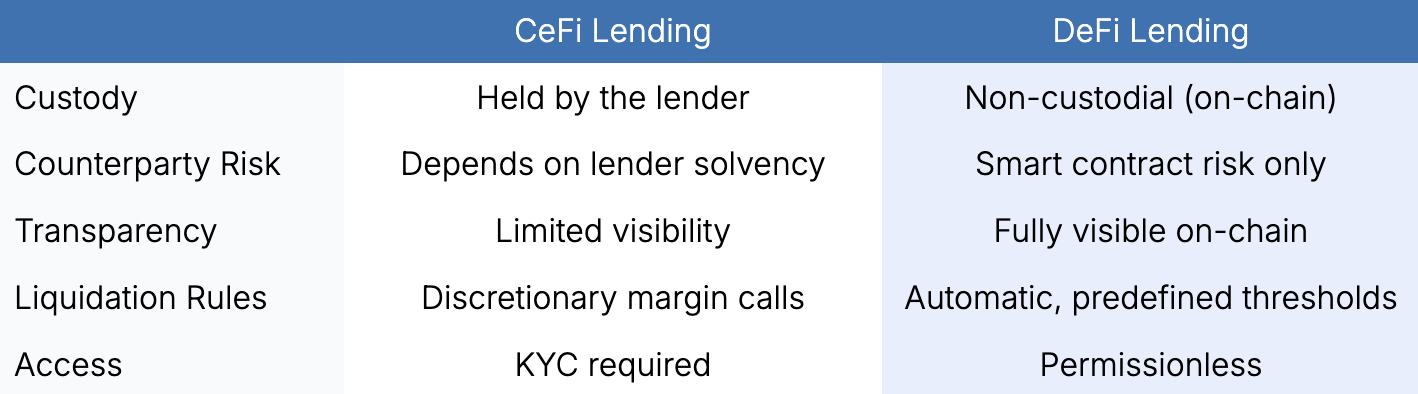
Protocols such as Aave and Morpho define accepted collateral assets, loan-to-value ratios, interest rates, and liquidation thresholds. These rules are transparent and enforced automatically on-chain. There are no discretionary margin calls and no reliance on centralized decision-making.
Because borrowing does not involve selling the underlying asset, crypto-backed loans typically do not trigger a taxable event at origination in many jurisdictions. This tax efficiency is one of the primary reasons long-term holders consider borrowing instead of selling.
DeFi Loans vs Centralized Crypto Lending
Crypto-backed loans exist in both centralized and decentralized forms, but the difference is material.
Centralized lenders require users to transfer custody of their assets. This introduces counterparty risk, as users depend on the lender's solvency and internal risk controls. The failures of several centralized lenders have shown how quickly this risk can materialize.
DeFi lending protocols operate non-custodially. Assets remain on-chain, governed by transparent rules enforced by code. Collateral ratios, interest rates, and liquidation mechanics are visible at all times.
For holders who value control and predictability, DeFi borrowing aligns more closely with long-term capital management.
Who Are Crypto-Backed Loans For?
Crypto-backed loans are not a universal solution. They are best suited to specific user profiles with clear needs.
1. Long-Term BTC and ETH Holders
The primary audience for crypto-backed loans is long-term Bitcoin and Ethereum holders who need liquidity but do not want to sell. These users typically have held BTC or ETH for multiple years, have significant unrealized gains, want to avoid triggering taxes, and view crypto as long-term capital.
For this group, borrowing is about accessing liquidity without breaking a position built over time. Conservative loan-to-value ratios and predictable risk matter more than maximizing leverage.
2. Capital-Efficient DeFi Users
A second segment includes experienced DeFi users who already borrow against crypto. These users are comfortable with on-chain borrowing mechanics, managing collateral and liquidation risk, and evaluating protocol-level trade-offs.
For them, crypto-backed loans are a way to improve capital efficiency rather than simply avoid selling. Automation and yield generation are key considerations.
Who Crypto-Backed Loans Are Not For
Crypto-backed loans are generally not appropriate for users who need most of their portfolio's value in cash, cannot tolerate exposure to market volatility, are unwilling to manage collateral risk, or do not understand liquidation mechanics.
Borrowing introduces leverage, even when used conservatively. It should be treated as a financial tool, not a shortcut.
The Limitation of Traditional Crypto-Backed Loans
While crypto-backed loans solve the problem of selling, traditional borrowing models introduce inefficiency.
In most DeFi protocols, collateral sits idle while securing the loan. Borrowers pay interest, but their deposited assets do not actively reduce borrowing costs. Over long time horizons, this creates unnecessary drag for users who plan to hold their collateral regardless.
For long-term holders, this often feels incomplete.
How Altitude Approaches Crypto-Backed Loans
Altitude was built to address this inefficiency.
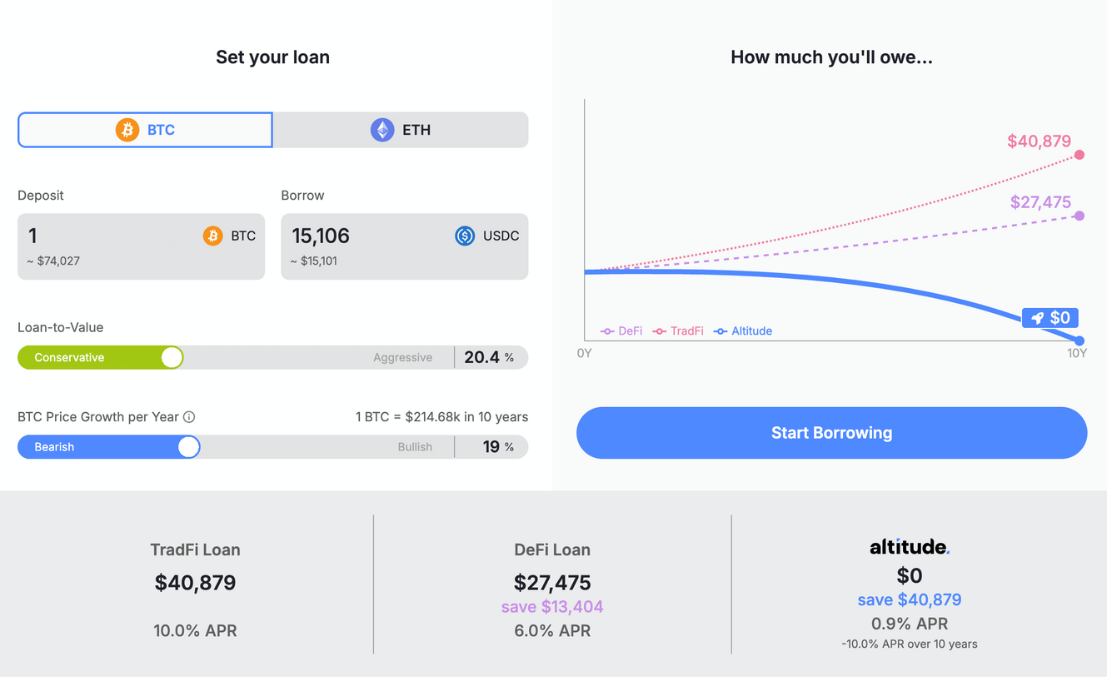
Instead of leaving collateral idle, Altitude deploys deposited BTC or ETH into yield-generating strategies built on established DeFi infrastructure like Aave and Morpho. The yield generated by the collateral is automatically applied to the loan balance over time.
This approach reduces effective borrowing costs, allows loan balances to decrease without manual repayments, and keeps capital productive while securing liquidity.
Altitude combines the security and liquidity of proven DeFi protocols with an additional layer of automation and simplicity. Learn more in the Altitude documentation.
Disclaimer: This article is for informational purposes only and does not constitute tax, legal, or financial advice. Consult a qualified professional regarding your specific situation.